The MIRIAM-2 Team took part in the 68th ESA parabolic flight campaign in Bordeaux from Nov. 28 to Dec. 6, 2017. The flight took place on Dec. 5th, 2017, where the deployment test of the balloon system was repeated after the mishap of the experiment in 2015.
Snow during our trip - what a surprise!
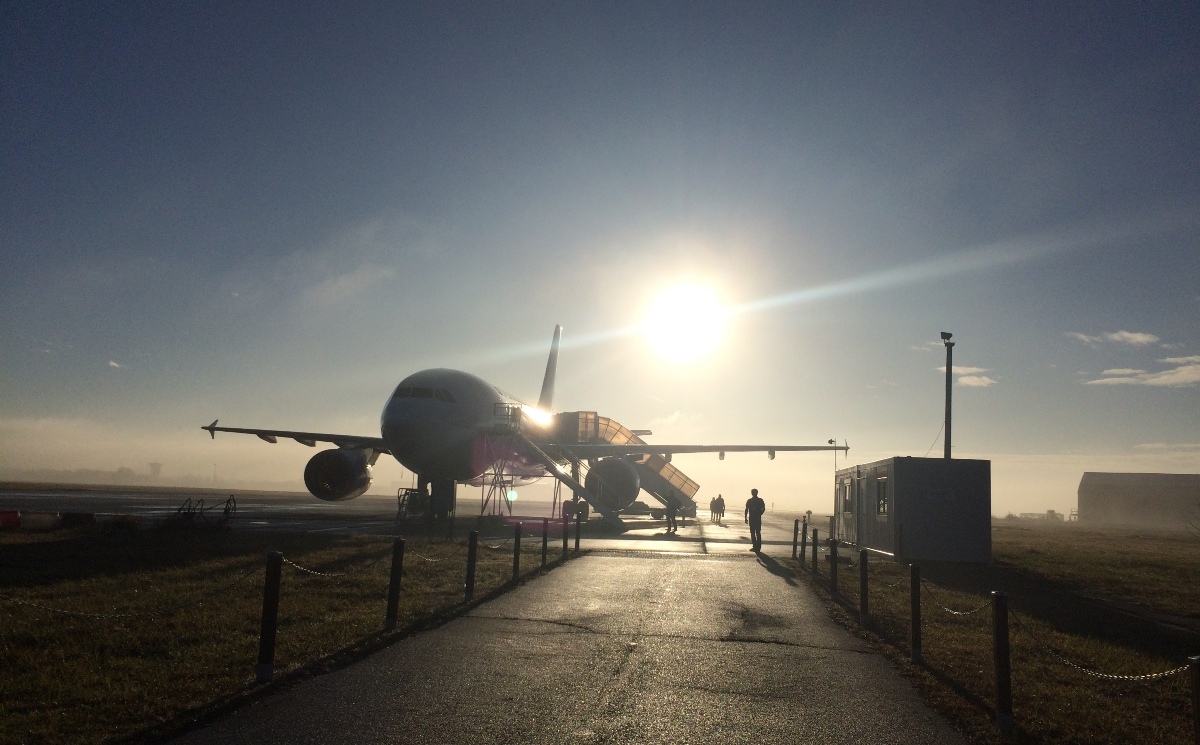
Morning encounter with the A310 Zero-G
Preparation week
We arrived in Bordeaux in the evening of Nov. 29 and could board our experiment after a speedy checkout on the day after, after only a short moment of shock when we found out our experiment is heavier than stated in the papers, but which could be cleared shortly after by Novespace after checking with safety requirements. Other experiments by that time were still assembling their stuff.
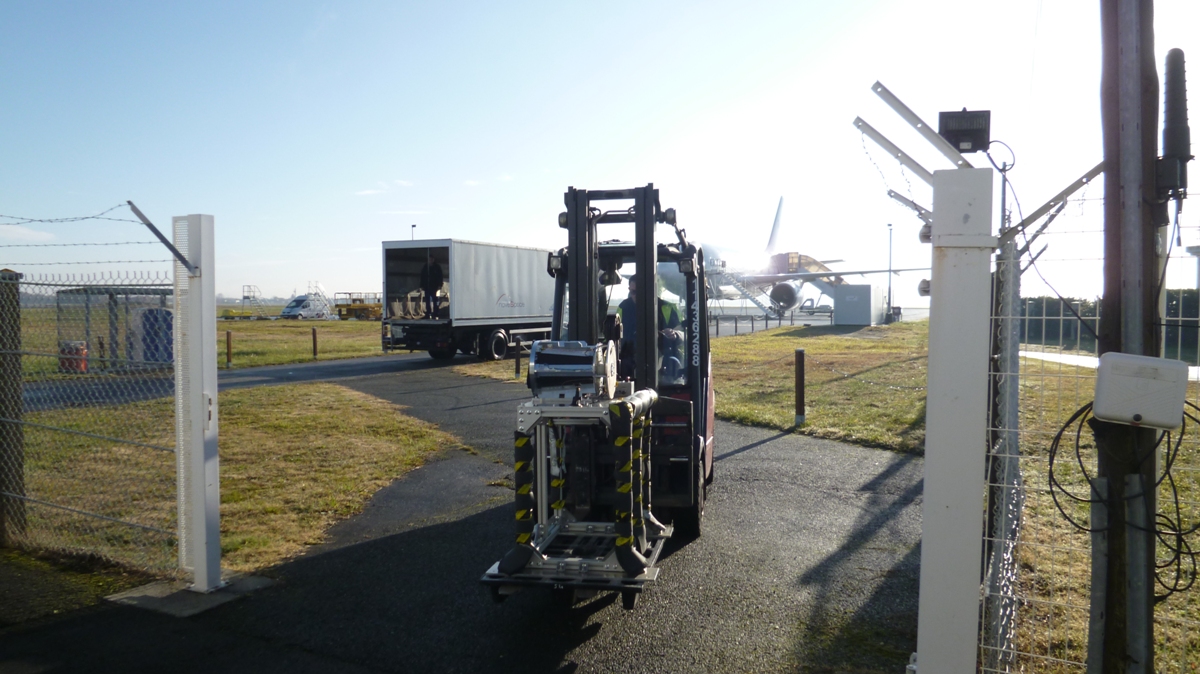
Boarding of the test rig
Applying of protective covers
It is really of advantage to already know the proceedings and to have an experiment that is already known.
The setup of the student team VESTAND
For the experiment above I flew again on the day after my flight with the MIRIAM-2 test, but this time (and the first time ever) as a test person. During this experiment it was examined how the vestibular system reacts to an electrical stimulation, once in a perception experiment and in the other half of the flight in a balance experiment.
Friday update: We passed our safety review and our experiment is cleared for flight! We also already received our flight suit (this time from ESA).
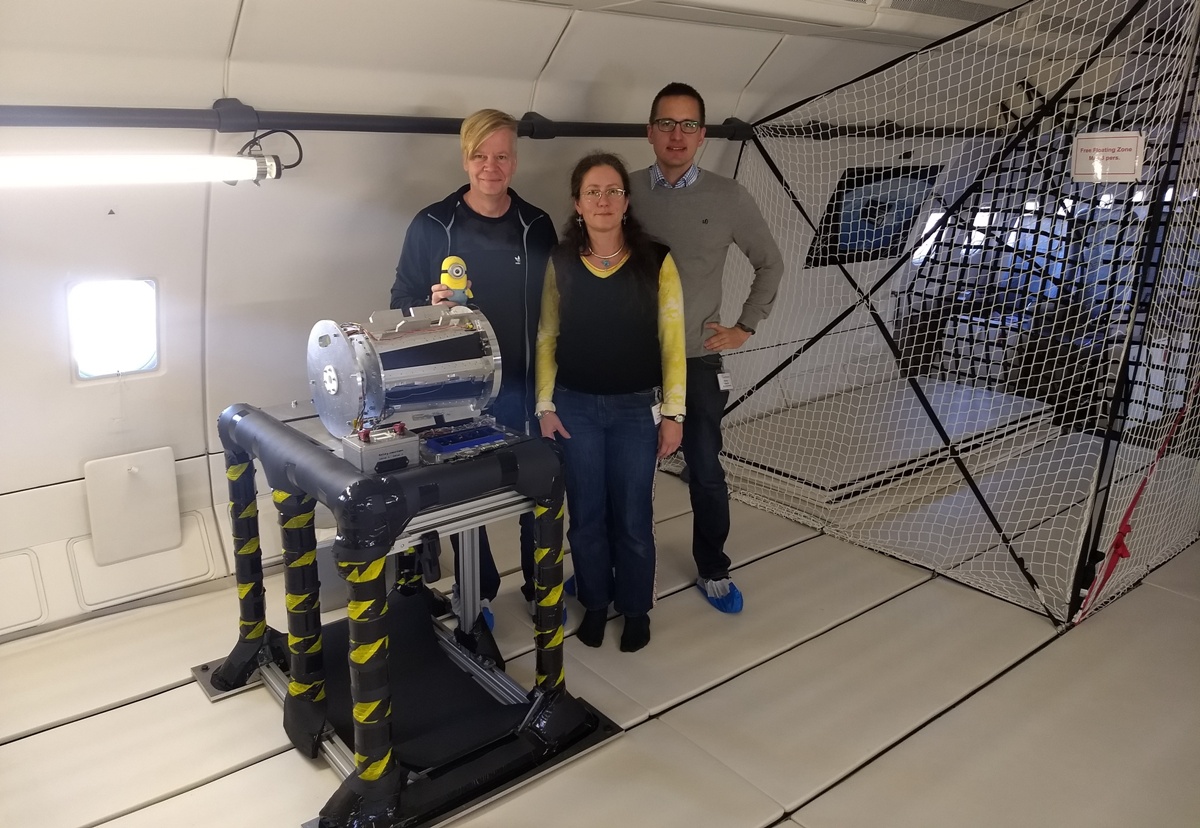
Our flight team (Tanja, left and Klaus, right) and backup Nicolay Kübler (middle)
The parabolic flight track can be followed live on Flightradar 24
Here is our timeline for Tuesday
Our team, from left Klaus Bayler, Tanja Lehmann, Nicolay Kübler
Evening at the Zero-G
A lot is going on in the aircraft
But we are ready except for some small things
Testrig now with the logos of our supporters
Trying out the Brainfly experiment
I also had the occasion to try out another experiment: For the "Fly your Thesis" student group Brainfly test persons control a computer game with their thoughts during parabolic flight. It works by imagining hand movements, which are recognized by a software reading out and evaluating the brainwave patterns of the subject. It didn't work very well for me and also Nicolay, no wonder the test persons had to train for 3 months so it works now for the parabolic flight.
Flight week
The type plate of the aircraft has been on the ISS with Thomas Pesquet (picture and name plate are now permanently located in the free float area)
Presentation of the flight maneuver in the briefing
On the morning before flight
We have checked everything and are ready! The aircraft doors close at 9:00 a.m. and then we take off!
Update flight day: The deployment of the balloon was successful!
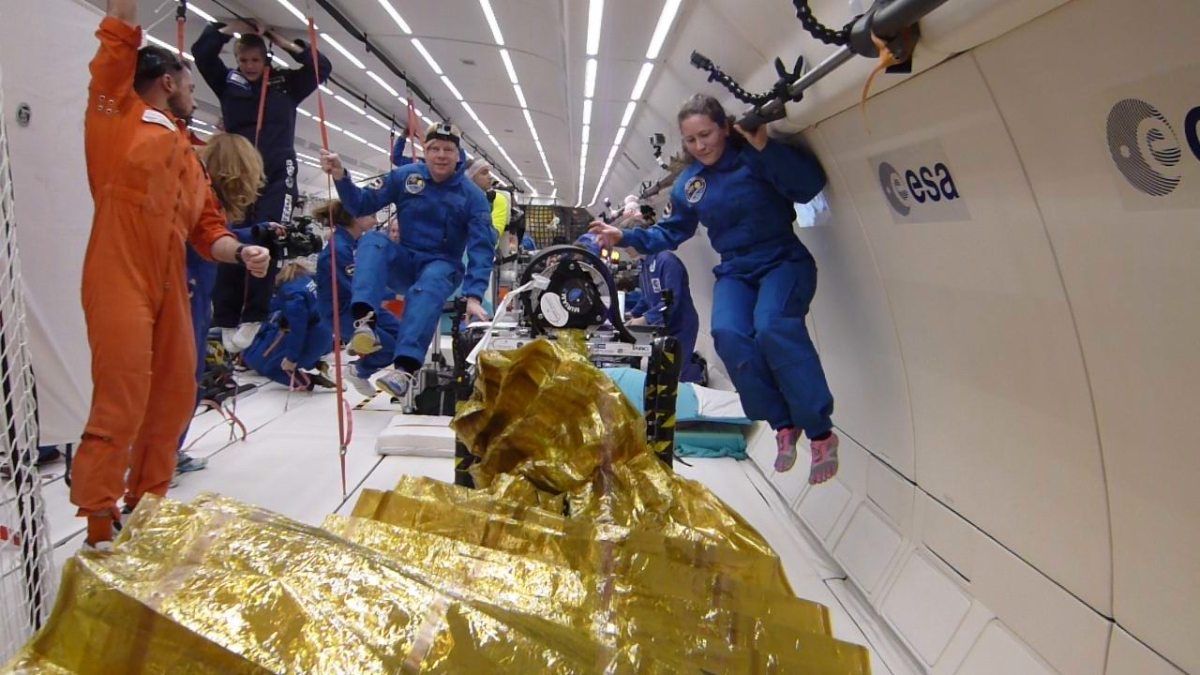
During the first flight of the 68th ESA parabolic flight campaign on Dec. 5, 2017 the qualification test of the MIRIAM-2 deployment mechanism was performed on board the Airbus A310 ZERO-G. During the 27th parabola of a total of 31 parabolas, the redundant pyro cutters were ignited and the balloon container was expelled by a spring force. Subsequently the container walls (we call them blossoms) flapped to outward and released the balloon package, and the pod and attached balloon material moved further away from the test rig. The balloon package got pre-unfolded and would have been ready for inflation, but this was not a part of this qualification test.
All four GoPro cameras recorded video data flawlessly and also the controller could successfully capture all sensor data.
This test of course is also listed in the ESA Erasmus Experiment Archive, together with the last test.
On Youtube you can see the complete test:
Besides that there is a video made by Sue Nelson from ESA-TV, in which our experiment is presented, it can be viewed here:
Two other videos from Tom Scott (3rd flight, where we were not part of, but nevertheless interesting):
Particularly impressive in this video is that the actual plane telemetry data were used to stabilise the shots to the horizon.
Furthermore I flew again on Dec. 6, as a test person for the 2017 "Fly your Thesis!" student group VESTAND. In this test the contribution of gravity to the perception of self-motion and standing balance responses evoked by electrical vestibular stimulation were investigated. The perception of a self-motion was tested in 1g, 2g and 0g conditions, and in the 2nd part of the test the reactions of the calf muscles during a standing balance test, unloaded at 1g and 2g, and then also at 1g and 0g with an additional spring load, same as own body weight to recreate a 1g load in 0g.
It was a very interesting experiment and I didn't think it would be so much fun taking part. In particular the perception trial was totally relaxing, especially just laying or better, floating and being able to just feel how it is. And also with the additional movement sensation from the stimulation, as if you get moved by someone while in 0g, but without any touch.
Also, getting 7 parabolas to just hang around in the unloaded standing trial, since there no test could be performed.
Originally I thought that I would not notice weightlessness when at the same time the body system is fooled into feeling another movement, but this is not the case. Because weightlessness is something that does not simply come from outside, no, it is something that can be felt within the body and becomes part of oneself.
Not to forget the Flashbacks after the flight, which I then always have. But this time it was or better is possible for me exceptionally well to even recall these floating feelings on purpose. What is really nice, I now call this the "zero-g smile" ;-). Unfortunately to this date no one could yet explain why this is possible.
Also there was another call from the student group BrainFly, which is about dreams in concurrence with parabolic (zero-g) flights, where I also participated. But this only consisted of filling out a questionnaire.